
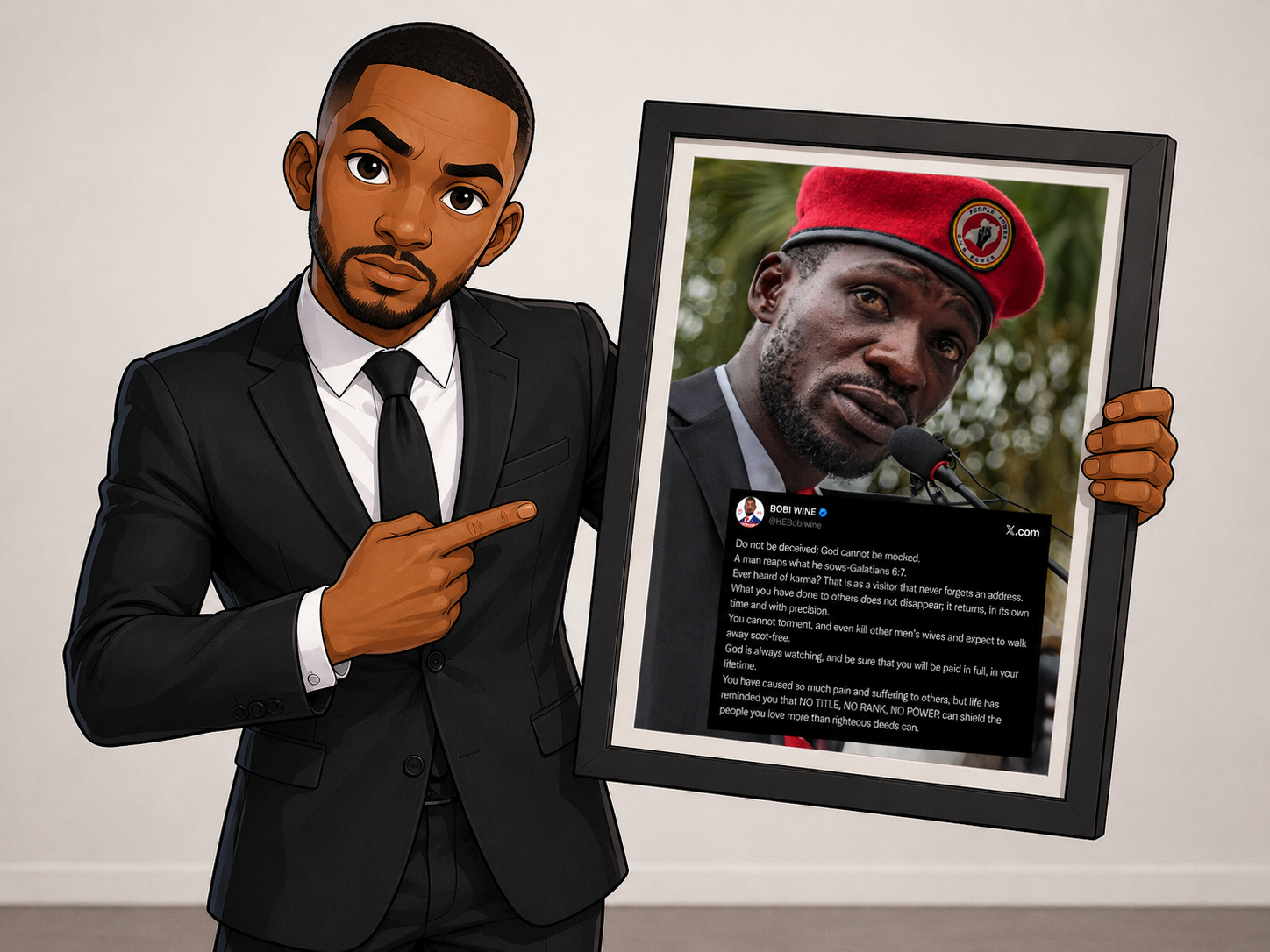
There are moments in politics when the country watches not for policy, not for ideology, but for character. How a leader responds to another person’s suffering often reveals more than years of campaign speeches ever could.
The recent response by opposition leader Bobi Wine to President Museveni’s statement about the illness and recovery of First Lady Janet Museveni was one such moment. Rather than offering even a brief word of compassion before making a political argument, his response framed the family’s suffering as divine punishment. He invoked Scripture, spoke of karma, declared that God cannot be mocked, and suggested that what had happened was the repayment of past deeds.
For many Ugandans, this was not strength. It was an uncalled-for display of pettiness.
Political rivalry is expected in any democracy. It is healthy to criticize those in power and to hold leaders accountable for their actions. But there is a difference between political accountability and celebrating, or appearing to celebrate, personal suffering. Leadership demands the maturity to recognize that distinction.
Perhaps the most troubling aspect of the statement was its selective use of Scripture. The Bible was quoted to justify a message of retribution, yet the same Bible teaches forgiveness, mercy, and restraint. Jesus rejected the principle of “an eye for an eye.” He taught that if someone strikes you on one cheek, you should turn the other also — not as an act of weakness, but as a rejection of endless cycles of hatred and vengeance.
A leader who quotes the Bible carries the responsibility to represent its message honestly, not selectively. Scripture cannot become a political weapon, with verses about judgment highlighted while teachings on compassion, forgiveness, and love for one’s enemies are quietly ignored. Faith should elevate public discourse, not inflame resentment.
History offers an instructive contrast.
When the helicopter carrying Gen. David Oyite Ojok crashed in Luwero in December 1983, Museveni reportedly instructed NRA fighters not to celebrate. Despite being on opposite sides of the conflict, he reminded them that Uganda had lost a good soldier. Whether one supports or opposes Museveni politically is beside the point. In that moment, he recognized that national leadership requires empathy even toward one’s adversaries.
That is what statesmanship looks like. It is the ability to separate political struggle from basic humanity.
By contrast, responding to the illness of an opponent’s spouse with language implying divine punishment does not project confidence. It projects bitterness. It sends the message that political rivalry extends even into moments of personal suffering. That is not the temperament Ugandans should expect from anyone aspiring to lead an entire nation.
This inevitably raises uncomfortable questions.
If compassion disappears when an opponent is at their most vulnerable, what happens when that opponent loses power altogether? If a leader cannot rise above pettiness while in opposition, what assurance do citizens have that such impulses would not grow stronger with the immense powers of the presidency?
These questions are not about predicting the future. They are about judging temperament.
Leadership is not tested when everything is going well. It is tested when emotion runs high, when political opportunity presents itself, and when a leader has the chance either to deepen divisions or to rise above them.
Uganda deserves leaders who can fiercely oppose one another’s ideas while refusing to lose their humanity. Citizens should expect conviction without cruelty, courage without vindictiveness, and accountability without celebrating personal pain.
Politics built on bitterness rarely ends with reconciliation. It breeds deeper resentment, greater polarization, and a society in which opponents are no longer viewed as fellow citizens but as enemies to be humiliated.
Every Ugandan should ask a simple question before entrusting anyone with the highest office in the land: does this person’s conduct in moments of another family’s suffering reflect the character of someone capable of leading all Ugandans?
For many who read that statement, the answer will not be reassuring.