
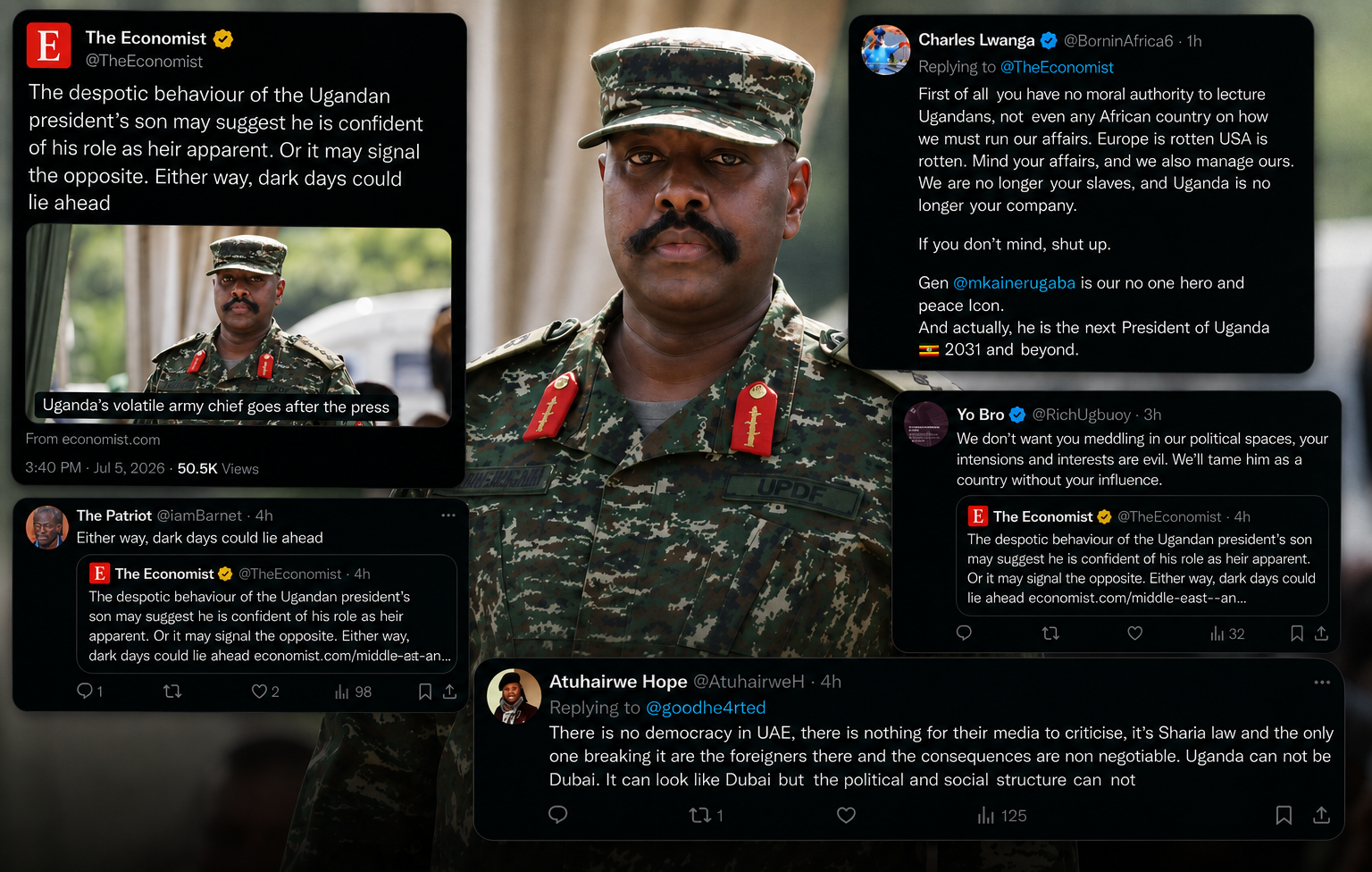
A fresh article published by The Economist has triggered heated reactions among Ugandans online after the magazine argued that the conduct of Chief of Defence Forces Gen. Muhoozi Kainerugaba could either signal confidence in his role as President Yoweri Museveni's eventual successor or indicate deeper political uncertainty.
The publication carried the headline "Uganda's volatile army chief goes after the press" and stated that "the despotic behaviour of the Ugandan president's son may suggest he is confident of his role as heir apparent. Or it may signal the opposite. Either way, dark days could lie ahead."
The article comes shortly after Gen. Muhoozi ordered the closure of Nation Media Group's Ugandan operations, including Daily Monitor and NTV Uganda, saying he did not believe in a free press. The shutdown drew condemnation from international media freedom organisations and rights groups, while Ugandan authorities said the action was linked to a security investigation.
The Economist also referenced broader concerns surrounding Uganda's political climate, including the detention of opposition figures, restrictions on media, and speculation over the country's future leadership.
On X, formerly Twitter, many Ugandans strongly rejected the magazine's assessment.
One user, Charles Lwanga, accused the publication of hypocrisy, writing that Western countries had "no moral authority" to lecture Uganda and insisting that Ugandans would determine their own future without foreign influence. He added that Gen. Muhoozi was "our number one hero and peace icon."
Another user, posting as Yo Bro, said the publication was meddling in Uganda's political affairs and argued that the country's internal issues should be resolved by Ugandans themselves.
Others echoed the magazine's concluding phrase, "Either way, dark days could lie ahead," while debating whether the article fairly reflected the country's current political trajectory.
Not every response defended the Ugandan government. Some social media users argued that the issues raised by The Economist deserved serious discussion, particularly regarding media freedom and democratic governance. Others countered that Uganda should not be judged using Western political standards and pointed to different governance models in other countries.
The debate highlights the increasingly polarised public conversation surrounding Gen. Muhoozi, who has become one of Uganda's most influential and controversial political figures. His outspoken use of social media, repeated interventions in political matters, and growing national profile have fueled long-running speculation that he could eventually succeed President Museveni, although no official succession plan has been announced.
With Uganda's political future remaining a subject of intense public interest, reactions to the article demonstrate how questions about leadership, press freedom, and national sovereignty continue to generate passionate debate both inside the country and internationally.